The Complete Guide to 3D Printing Materials in 2026
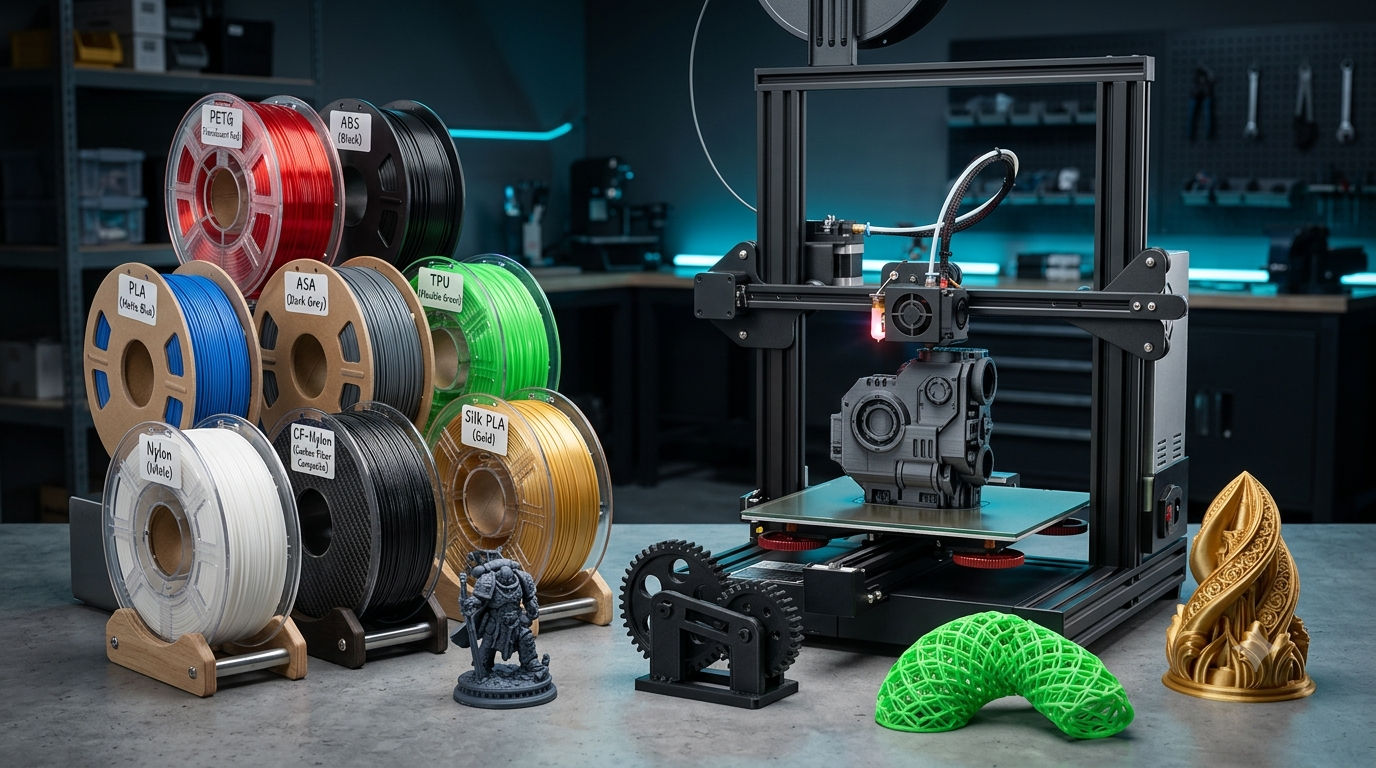
Choosing the right material is one of the most important decisions in 3D printing. The material affects everything from print quality and strength to flexibility, heat resistance, appearance, durability, and cost. In 2026, 3D printing materials are more diverse than ever. Whether you're printing a personalized gift, a decorative model, a replacement part, a functional prototype, or an engineering component, there is a material designed for the job. This guide explains the most popular 3D printing materials and helps you choose the right one for your project.🧵 1. PLA – The Best Choice for Everyday 3D Printing
PLA (Polylactic Acid) remains one of the most popular materials for 3D printing. It is relatively easy to print, produces excellent surface quality, and is available in a huge variety of colors, finishes, and specialty formulations.Best for
- Decorative models
- Figurines and collectibles
- Personalized gifts
- Home décor
- Prototypes
- Lithophanes
- Educational models
- Display pieces
Advantages
- Easy to print
- Excellent detail
- Wide range of colors
- Low tendency to warp
- Good surface finish
- Available in many specialty versions
Limitations
PLA is not the best choice for parts exposed to high temperatures or demanding mechanical environments. Its temperature resistance is lower than materials such as ABS, ASA, Nylon, and Polycarbonate. Best choice when: appearance, detail, affordability, and ease of printing are more important than high-temperature performance.🧪 2. PETG – The Versatile All-Rounder
PETG (Polyethylene Terephthalate Glycol-modified) offers a useful balance between printability, toughness, chemical resistance, and durability. It is often chosen when PLA isn't durable enough but a more demanding engineering material isn't necessary.Best for
- Functional parts
- Brackets
- Containers
- Prototypes
- Tools
- Mechanical components
- Indoor and selected outdoor applications
Advantages
- Good impact resistance
- Good layer adhesion
- Chemical resistance
- Good durability
- Relatively easy to print
- Better environmental resistance than PLA
Limitations
PETG can be more prone to stringing than PLA and requires careful print settings for clean results. Best choice when: you need a strong, practical material that is still relatively easy to print.🔥 3. ABS – For Tougher and More Heat-Resistant Parts
ABS (Acrylonitrile Butadiene Styrene) is a long-established engineering thermoplastic used for functional prototypes and end-use parts. Compared with PLA, ABS generally provides better heat resistance and toughness, but it is more challenging to print.Best for
- Mechanical components
- Functional prototypes
- Automotive-related parts
- Housings and enclosures
- Parts exposed to higher temperatures
Advantages
- Good toughness
- Good impact resistance
- Higher heat resistance than PLA
- Suitable for functional applications
- Can be post-processed for a smoother appearance
Limitations
- More prone to warping
- Requires careful temperature control
- Usually benefits from an enclosed printer
- Printing should be performed with appropriate ventilation
☀️ 4. ASA – A Strong Choice for Outdoor Applications
ASA (Acrylonitrile Styrene Acrylate) is particularly useful when a printed part needs to withstand outdoor conditions. Its UV resistance makes it a popular option for applications where prolonged exposure to sunlight is expected.Best for
- Outdoor components
- Automotive accessories
- Outdoor enclosures
- Mounting brackets
- Garden and equipment parts
Advantages
- Good UV resistance
- Good weather resistance
- Good mechanical properties
- Better suited to outdoor use than standard PLA or ABS
Limitations
ASA can be more difficult to print than PLA and requires good temperature control. Best choice when: your 3D printed part will spend significant time outdoors.🧤 5. TPU – When You Need Flexibility
TPU (Thermoplastic Polyurethane) is a flexible material with rubber-like characteristics. Instead of creating a rigid object, TPU can produce parts that bend, compress, stretch, and absorb impacts.Best for
- Phone cases
- Flexible covers
- Gaskets
- Protective parts
- Feet and bumpers
- Wearable accessories
- Flexible hinges
Advantages
- Flexible
- Impact resistant
- Abrasion resistant
- Excellent for protective applications
Limitations
Flexible filament can be more difficult to print than rigid materials and often requires slower printing and appropriate extrusion hardware. Best choice when: your product needs flexibility, cushioning, or impact resistance.⚙️ 6. Nylon – For Demanding Functional Parts
Nylon (Polyamide) is an engineering material known for strength, durability, flexibility, and resistance to wear. It is particularly useful for functional parts that experience mechanical stress.Best for
- Gears
- Hinges
- Mechanical components
- Replacement parts
- Fixtures
- Moving components
- Functional prototypes
Advantages
- Strong
- Tough
- Wear resistant
- Good chemical resistance
- Some flexibility
- Suitable for mechanically demanding parts
Important consideration
Nylon is hygroscopic, meaning it absorbs moisture from the environment. Moisture can negatively affect printing performance and part quality, so proper storage and drying are important. Best choice when: mechanical performance and durability matter more than simple printability.🧱 7. Polycarbonate (PC) – High Strength and Heat Resistance
Polycarbonate (PC) is a strong and tough engineering thermoplastic with good heat resistance. It is generally more demanding to print than common materials such as PLA and PETG.Best for
- Engineering prototypes
- Strong functional components
- Mechanical parts
- High-temperature applications
- Industrial applications
Advantages
- High strength
- High toughness
- Good heat resistance
- Suitable for demanding applications
Limitations
PC typically requires a printer capable of maintaining higher temperatures and controlling the printing environment. Best choice when: you need a stronger, more heat-resistant material and have suitable printing equipment.🪶 8. Carbon Fiber and Other Composite Filaments
Composite filaments combine a polymer with reinforcing materials such as carbon fiber or glass fiber. These materials can improve stiffness, strength-to-weight performance, and dimensional stability for certain applications.Common examples
- Carbon-fiber reinforced Nylon
- Carbon-fiber reinforced PETG
- Carbon-fiber reinforced ABS
- Glass-fiber reinforced polymers
Best for
- Engineering components
- Lightweight structures
- Fixtures
- Manufacturing aids
- High-performance prototypes
- Replacement components
Important consideration
Fiber-filled materials can be abrasive and may require an appropriate hardened nozzle or wear-resistant print hardware. Best choice when: you need increased stiffness or mechanical performance and have a printer equipped for composite materials.💧 9. PVA and Water-Soluble Support Materials
Some 3D prints contain complex overhangs, cavities, or geometries that are difficult to support using the same material as the model. PVA (Polyvinyl Alcohol) is a water-soluble support material commonly used with compatible multi-material systems. After printing, the support can be dissolved in water.Best for
- Complex models
- Internal cavities
- Difficult overhangs
- Multi-material printing
- Highly detailed geometries
🧴 10. Resin – For High Detail and Smooth Surfaces
Resin printing technologies such as SLA and DLP use photopolymer resin rather than filament. Resin printing is especially useful when fine details and smooth surfaces are priorities.Best for
- Miniatures
- Figurines
- Jewelry prototypes
- Highly detailed models
- Small decorative objects
- Dental and specialized applications
📊 3D Printing Material Comparison
| Material | Strength | Flexibility | Heat Resistance | Ease of Printing | Best For | |---|---|---|---|---|---| | PLA | ⭐⭐⭐ | ⭐ | ⭐⭐ | ⭐⭐⭐⭐⭐ | Models, gifts, décor | | PETG | ⭐⭐⭐⭐ | ⭐⭐ | ⭐⭐⭐ | ⭐⭐⭐⭐ | Functional parts | | ABS | ⭐⭐⭐⭐ | ⭐⭐⭐ | ⭐⭐⭐⭐ | ⭐⭐⭐ | Engineering parts | | ASA | ⭐⭐⭐⭐ | ⭐⭐⭐ | ⭐⭐⭐⭐ | ⭐⭐⭐ | Outdoor applications | | TPU | ⭐⭐⭐ | ⭐⭐⭐⭐⭐ | ⭐⭐⭐ | ⭐⭐⭐ | Flexible products | | Nylon | ⭐⭐⭐⭐⭐ | ⭐⭐⭐⭐ | ⭐⭐⭐⭐ | ⭐⭐ | Mechanical parts | | PC | ⭐⭐⭐⭐⭐ | ⭐⭐⭐ | ⭐⭐⭐⭐⭐ | ⭐⭐ | High-performance parts | | CF Composites | ⭐⭐⭐⭐⭐ | ⭐⭐ | ⭐⭐⭐⭐ | ⭐⭐ | Strong & rigid parts | | Resin | ⭐⭐⭐ | Varies | Varies | ⭐⭐⭐ | High-detail models |Note: Ratings are general guidance. Actual performance varies considerably by specific material formulation, printer, print orientation, layer settings, and manufacturer.
🧠 How to Choose the Right Material
Instead of asking "Which filament is strongest?", start by asking what your finished product actually needs to do.For decorative models
Choose PLA or resin when appearance and detail are the priority.For everyday functional parts
Choose PETG when you need a good balance between strength, durability, and printability.For outdoor products
Consider ASA when UV and weather resistance are important.For flexible products
Choose TPU for rubber-like flexibility and impact resistance.For mechanical components
Consider Nylon, PC, or reinforced composites, depending on the required mechanical and thermal performance.For extremely detailed models
Consider resin printing, particularly for miniatures and small models where fine detail is critical.🌡️ Material Is Only One Part of the Equation
A strong filament does not automatically produce a strong part. Final performance can also depend on:- Print orientation
- Layer height
- Wall thickness
- Infill percentage
- Infill pattern
- Nozzle temperature
- Bed temperature
- Print speed
- Cooling
- Moisture in the filament
- Post-processing
- Printer calibration